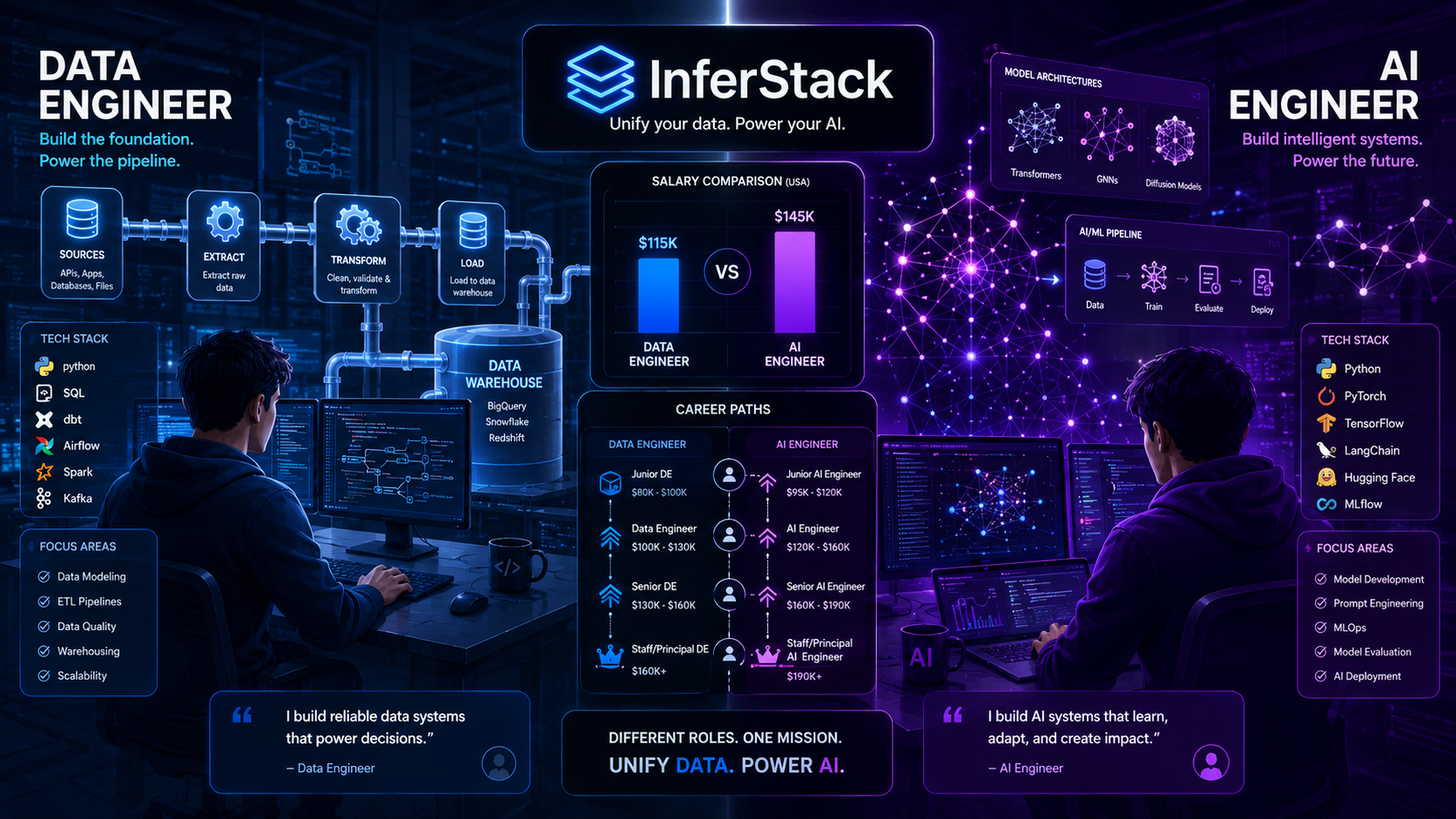
Data engineering vs AI engineering — which path should you choose in 2026? We break down the skills, tools, salaries, and career trajectories for both roles so you can make the smartest move for your future in tech.
The Hottest Debate in Tech: Data Engineer or AI Engineer?
Walk into any tech conference in 2026 and you will hear the same question buzzing through every conversation: should I be a data engineer or an AI engineer? It is the career crossroads that thousands of developers, analysts, and computer science graduates are navigating right now, and the stakes have never been higher. Both roles sit at the intersection of technology and business value, both are commanding eye-watering salaries, and both are evolving at a pace that makes last year's skill set feel dated.
But here is the uncomfortable truth most career guides won't tell you: these two roles are not actually at war with each other. They are two sides of the same coin, and the professionals who understand both will be the most valuable people in the room for the next decade. This article cuts through the hype to give you an honest, detailed breakdown of what each role actually involves, which pays more in 2026, what the career paths look like, and — most importantly — which one you should pursue based on your specific strengths and goals.
What Does a Data Engineer Actually Do?
A data engineer is, at the most fundamental level, a builder of data infrastructure. They are the professionals who ensure that data flows reliably, efficiently, and securely from wherever it originates to wherever it needs to go — and that when it arrives, it is clean, structured, and ready to be consumed by analysts, data scientists, machine learning systems, and business applications.
On a typical day, a senior data engineer might design a new ingestion pipeline using Apache Kafka to capture real-time clickstream events from a mobile application, write dbt models to transform raw transactional records into a business-ready star schema in Snowflake, debug a failing Airflow DAG that orchestrates the nightly ETL from a third-party SaaS platform, review a pull request that adds schema validation tests to a production data model, and respond to an alert from the data observability platform indicating that row counts in a critical table dropped by 40 percent compared to the previous day.
Data engineers are the unsung heroes of the data world. Without their work, data scientists have no data to analyze, machine learning engineers have no features to train on, and business intelligence dashboards show nothing but blank charts. The data engineering discipline demands a rare combination of software engineering rigor, systems thinking, cloud infrastructure expertise, and an almost obsessive attention to data quality and reliability.
The core technical stack for a data engineer in 2026 includes Python and SQL as foundational languages, Apache Kafka or AWS Kinesis for streaming ingestion, Apache Spark or Databricks for large-scale distributed processing, dbt for SQL-based transformation, Apache Airflow, Prefect, or Dagster for workflow orchestration, a cloud data warehouse such as Snowflake, Google BigQuery, or Amazon Redshift, and a cloud provider platform — AWS, GCP, or Azure — for infrastructure provisioning and management.
What Does an AI Engineer Actually Do?
An AI engineer occupies the frontier where data meets intelligence. Where a data engineer builds the roads that data travels on, an AI engineer builds the vehicles — the models, systems, and applications that consume data and transform it into predictions, decisions, recommendations, and generated content.
The AI engineering role has expanded dramatically since the large language model revolution of the early 2020s. Today's AI engineers are not just training neural networks in isolation; they are building production systems that integrate LLMs, vector databases, retrieval-augmented generation (RAG) pipelines, multi-modal models, and autonomous AI agents into real-world applications that handle millions of user interactions daily.
A senior AI engineer's day in 2026 might look like this: fine-tuning an open-source LLM on proprietary company data using parameter-efficient techniques like LoRA, evaluating the performance of a RAG pipeline against a curated benchmark dataset, debugging a model serving endpoint that is producing inconsistent outputs under high load, collaborating with the data engineering team to design a feature store that serves both online inference and offline model training, and reviewing the bias and fairness metrics of a deployed recommendation model before approving its promotion to production traffic.
The core technical stack for an AI engineer in 2026 includes Python as the primary language, PyTorch or JAX as the deep learning framework of choice, Hugging Face Transformers and the broader Hugging Face ecosystem for working with pre-trained models, vector databases like Pinecone, Weaviate, or Chroma for embedding storage and semantic search, LangChain or LlamaIndex for building LLM application chains, MLflow or Weights and Biases for experiment tracking, Kubeflow or Sagemaker for MLOps and model deployment, and cloud GPU infrastructure for training and serving at scale.
Skills Overlap: More Common Ground Than You Think
One of the most surprising findings for anyone studying these two career paths closely is just how much overlap exists between the core competencies. Both roles require strong Python programming skills — not just scripting-level Python, but production-quality, well-tested, version-controlled Python code that follows software engineering best practices. Both roles demand a solid understanding of distributed computing, since neither Spark jobs nor large-scale model training happen on a single machine. Both involve deep engagement with cloud platforms, containerization with Docker and Kubernetes, and the operational discipline required to run complex systems reliably in production.
Data engineers and AI engineers also share a common dependency: data quality. The garbage-in, garbage-out principle applies with equal force to both analytical pipelines and machine learning models. An AI model trained on poorly governed, inconsistent, or biased data will produce unreliable predictions regardless of how sophisticated its architecture is. This is why the most effective AI engineering teams invest heavily in data engineering capabilities — clean, well-structured, richly featured training data is the single biggest lever for improving model performance in production.
Where They Diverge: The Fundamental Difference in Mindset
Despite their significant overlap, data engineers and AI engineers approach problems with fundamentally different mindsets, and this cognitive difference is where the real distinction between the roles emerges.
Data engineers think in terms of systems and flows. They are obsessed with reliability, latency, throughput, and correctness. They ask: how does data get from point A to point B with zero loss, maximum freshness, and guaranteed schema compliance? Their success metrics are pipeline uptime, data freshness SLAs, and the number of data quality incidents per month. They architect for repeatability and determinism.
AI engineers think in terms of probability and optimization. They are comfortable with uncertainty, statistical trade-offs, and the inherent non-determinism of machine learning systems. They ask: how do we build a model that generalizes well to unseen data, operates within latency and cost budgets in production, and continues to perform accurately as the real-world data distribution shifts over time? Their success metrics are model accuracy, inference latency, cost per prediction, and business impact metrics tied to the model's decisions.
This mindset difference has practical implications for the work environment. Data engineers tend to spend more time collaborating with analytics and business intelligence teams, ensuring that data products are accurate and accessible. AI engineers spend more time collaborating with product teams and researchers, iterating rapidly on model performance and user experience.
Salary Comparison: Who Earns More in 2026?
Let's talk about money — because this is what drives many people's career decisions. The honest answer is that both roles pay exceptionally well by any standard, and the gap between them is smaller than the hype suggests. Here is a realistic breakdown of compensation ranges in the US market for 2026:
For data engineers, junior engineers with one to three years of experience typically earn between $95,000 and $130,000 annually. Mid-level engineers with three to six years of experience and expertise in cloud platforms and streaming technologies earn between $135,000 and $175,000. Senior data engineers and staff engineers with deep expertise in building large-scale data platforms at top-tier companies command between $180,000 and $250,000 in total compensation, including base salary, bonus, and equity.
For AI engineers, the ranges shift upward at each tier. Junior AI engineers earn between $110,000 and $145,000. Mid-level AI engineers with production ML deployment experience earn between $155,000 and $200,000. Senior and staff AI engineers, particularly those with expertise in large language model systems or ML infrastructure, command between $210,000 and $320,000 or more in total compensation at leading AI companies and Big Tech firms.
The premium for AI engineering is real but not as dramatic as headlines often suggest. The higher AI engineering salaries are concentrated at a relatively small number of AI-first companies where competition for talent is extreme. Across a broader sample of companies — enterprises, scale-ups, and established tech companies — the salary difference between a strong senior data engineer and a mid-level AI engineer is often negligible. What matters far more than which title you hold is the depth of your expertise, the complexity of the problems you have solved, and your ability to demonstrate clear business impact.
Career Growth and Job Market Outlook
Both career paths offer exceptional growth trajectories, but they diverge in interesting ways as you advance. Data engineering career paths typically evolve from junior data engineer to senior data engineer to staff or principal data engineer to data engineering manager or director of data engineering or VP of Data. In some organizations, experienced data engineers transition into architect roles, focusing on the design of enterprise-wide data platform strategies without the day-to-day coding responsibilities.
AI engineering career paths follow a similar ladder but branch more dramatically at the senior level. Senior AI engineers can move into machine learning research roles, founding AI-focused startups, leading AI product development as an AI product lead, or transitioning into the emerging category of AI systems architect — responsible for designing how AI capabilities are integrated across an entire organization's product portfolio.
In terms of raw job market demand, both roles are experiencing sustained high demand. Data engineering job postings have grown steadily as more companies undergo digital transformation and recognize that their AI ambitions cannot be realized without solid data infrastructure. AI engineering demand has grown explosively, particularly for engineers with LLM application development and MLOps experience. The Bureau of Labor Statistics and major job market analytics platforms consistently rank both roles among the top ten fastest-growing technical careers in the United States.
Which Should You Choose? A Framework for Deciding
The right choice between data engineering and AI engineering depends on factors that are deeply personal, and there is genuinely no universally correct answer. Here is a practical decision framework to help you navigate the choice.
Choose data engineering if you love building systems that are elegant, reliable, and scalable at the infrastructure level. If you get satisfaction from knowing that your pipeline processed 10 billion events today without a single failure, from designing a schema that serves both the analytics team and the ML team perfectly, or from solving the puzzle of how to ingest 50 different data sources without creating a tangled mess — data engineering is your natural home. It is also the stronger choice if you want a broader range of employer options, since virtually every company that handles data needs data engineers, while AI engineering roles are more concentrated at technology-forward organizations.
Choose AI engineering if you are energized by the idea of building systems that learn and improve, by the challenge of making models work reliably in messy real-world conditions, and by the prospect of working at the very frontier of what software can do. If you want to build the systems that power the next generation of intelligent products — from AI assistants to medical diagnosis tools to autonomous systems — AI engineering puts you at the center of the most significant technological shift of our era.
And if you genuinely cannot decide between the two, consider this: the most in-demand professionals in 2026 are not purely one or the other. They are ML Platform Engineers and AI Data Engineers — hybrid practitioners who understand both how to build the data infrastructure that feeds AI systems and how to operationalize those systems at scale. Companies pay a significant premium for engineers who can bridge the gap between the data engineering and AI engineering disciplines, because those individuals eliminate the most common bottleneck in AI product development: the handoff between data infrastructure and model deployment.
The InferStack Perspective: Building for Both
At InferStack, we believe the data engineering vs AI engineering debate is a false dichotomy. The organizations that will win in the AI economy are not those that hire exclusively for one discipline or the other — they are those that build integrated data and AI platforms where the two capabilities reinforce each other. Clean, well-governed data pipelines feed better AI models. Better AI models drive smarter data collection strategies. The feedback loop between data engineering and AI engineering is the engine of continuous competitive advantage.
Whether you are building your career in data engineering, AI engineering, or the exciting space between them, investing in a strong foundation in data infrastructure will pay dividends at every stage of your journey. The engineers who understand how data is created, moved, stored, and governed will always have an edge — because without that foundation, even the most sophisticated AI remains a house built on sand.
Conclusion
Data engineering and AI engineering are both outstanding career choices in 2026, offering exceptional salaries, intellectual challenge, and genuine impact on how the world works. Data engineering provides the infrastructure backbone that every data-driven organization depends on; AI engineering builds the intelligent systems that create competitive differentiation and transform user experiences. The most powerful insight you can take from this comparison is not which role pays a few thousand dollars more — it is that the future belongs to professionals who can think across both disciplines, speak both languages, and build systems where great data infrastructure and great AI capabilities reinforce each other to create something neither could achieve alone.
Frequently Asked Questions
Q. What is the difference between data engineering and AI engineering?
Data engineering focuses on building and maintaining the infrastructure that moves, stores, and processes data — pipelines, warehouses, and lakes. AI engineering focuses on designing, training, deploying, and monitoring machine learning and deep learning models that generate predictions and decisions. In practice, the two roles are increasingly interdependent.
Q. Which pays more — data engineering or AI engineering in 2026?
AI engineers command slightly higher median salaries in 2026, averaging $175,000–$220,000 annually in the US, compared to data engineers at $145,000–$185,000. However, senior data engineers with cloud and streaming expertise often match or exceed junior AI engineering salaries.
Q. Can a data engineer transition to AI engineering?
Absolutely. Data engineers already possess many foundational skills — Python programming, distributed computing, and cloud infrastructure — that translate directly to AI engineering. Adding machine learning fundamentals, MLOps practices, and deep learning frameworks like PyTorch is the typical transition path.
Q. What skills does an AI engineer need in 2026?
AI engineers need proficiency in Python, machine learning frameworks (PyTorch, TensorFlow, JAX), MLOps platforms (MLflow, Kubeflow, SageMaker), LLM fine-tuning and RAG architectures, vector databases, and cloud deployment of ML models at scale.
Q. Should I learn data engineering before AI engineering?
Yes, for most people. Understanding how data flows, how to build reliable pipelines, and how to manage data quality at scale makes you a significantly more effective AI engineer. Poor data infrastructure is the number one cause of failed AI projects in production.