The data lakehouse is reshaping how modern companies store, govern, and analyze data. In this deep dive, we explain what a lakehouse is, why forward-thinking engineering teams are converging on this architecture, and which platforms are leading the charge in 2026.
The Architecture That's Changing Everything
For nearly two decades, data teams faced a choice that felt like picking the lesser of two evils. They could build a data lake — a sprawling, low-cost storage system on cloud object storage that could hold any type of data in any format, but that turned into an unmanageable swamp the moment governance became an afterthought. Or they could build a data warehouse — a high-performance, well-governed analytical engine with SQL support and ACID transactions, but one that came with eye-watering costs, rigid schemas that struggled with semi-structured data, and a fundamental inability to serve the machine learning workloads that modern AI-driven organizations desperately need.
Neither option was truly satisfactory. Data lakes accumulated petabytes of raw, ungoverned data that analysts couldn't query efficiently and data scientists couldn't trust. Data warehouses became expensive bottlenecks that couldn't handle the diversity and volume of modern data workloads — especially the unstructured text, images, and event streams that power today's AI applications. Data teams spent enormous energy maintaining two separate systems, synchronizing data between them, and managing the operational overhead of running both in parallel. The results were inevitable: duplicated data, inconsistent definitions, escalating costs, and a constant organizational tension between the "lake team" and the "warehouse team."
The data lakehouse was born from the recognition that this forced choice was unnecessary. And in 2026, it has graduated from an architectural concept to the dominant paradigm for modern enterprise data platforms. This is the story of why it happened, how it works, which platforms are winning, and what your organization needs to know to make the right architectural decisions today.
What Exactly Is a Data Lakehouse?
A data lakehouse is a data architecture that layers warehouse-like capabilities — ACID transactions, schema enforcement, data versioning, fine-grained access control, and high-performance SQL query optimization — directly on top of low-cost cloud object storage (Amazon S3, Azure Data Lake Storage, or Google Cloud Storage). The key insight is that the performance and governance features that historically required a proprietary warehouse engine can now be implemented as an open metadata and transaction management layer sitting between the raw storage and the query engines that read from it.
The technical foundation of the lakehouse is the open table format: a standardized way of organizing data files and their metadata on object storage so that multiple different query engines can read from and write to the same data in a transactionally consistent way. The three leading open table formats are Apache Iceberg, Delta Lake, and Apache Hudi. Each provides the same core capabilities — ACID transactions, time travel (the ability to query data as it existed at any point in history), schema evolution (safely adding, renaming, or dropping columns), partition evolution (changing how data is physically organized without rewriting the entire dataset), and efficient incremental reads for streaming and CDC workloads.
On top of the open table format layer, organizations can plug in whichever query engines best suit their workloads. Apache Spark handles large-scale batch processing and machine learning feature engineering. Apache Flink enables real-time streaming ingestion directly into lakehouse tables. Trino or Apache Spark SQL serve interactive analytical queries for BI tools. Snowflake and Google BigQuery can now query Iceberg tables directly, giving warehouse users access to lakehouse data without sacrificing their familiar warehouse experience. This engine interoperability is the killer feature that data lakes never offered and proprietary data warehouses couldn't provide.
Why Data Lakes Failed at Scale
To truly understand why the lakehouse is winning, you need to understand why the data lake — despite its apparent advantages of low cost and flexibility — failed so consistently as organizations tried to scale it beyond the initial proof of concept.
The first failure was ACID compliance. Traditional data lake storage on S3 or ADLS operates at the file level, not the row or record level. When multiple writers try to update the same dataset simultaneously, there is no mechanism to prevent data corruption. When a large write operation fails halfway through, there is no automatic rollback — you end up with a partially updated, inconsistent dataset that is extremely difficult to recover. This made data lakes unsuitable for workloads that required reliable, consistent updates, which includes almost every operational analytics use case.
The second failure was query performance. Data lake files are typically stored in a flat directory structure with limited metadata. When a query engine needs to find all records matching a specific filter condition, it must scan every file in the relevant partition — a process known as full partition scan. As datasets grew to petabytes spread across millions of small files, query latency became unacceptable for interactive BI workloads. Data teams tried to compensate with elaborate compaction jobs, custom partitioning strategies, and caching layers, but these workarounds added operational complexity without fundamentally solving the problem.
The third failure was data governance and compliance. Data lakes made it trivially easy to write data in but nearly impossible to manage what was inside. When a user requested that their personal data be deleted under GDPR's right to erasure, the data engineering team faced the nightmare of tracking down every record containing that user's data across hundreds of Parquet files spread across dozens of S3 prefixes — and then rewriting all those files to remove the affected records, without any guarantee that they had found every instance. Row-level delete operations that a data warehouse could execute in milliseconds took hours of painful, error-prone manual work in a traditional data lake.
Why Data Warehouses Became a Ceiling
Data warehouses solved the governance and query performance problems that plagued data lakes, but introduced a different set of constraints that became increasingly painful as organizations' data ambitions grew.
The most significant constraint was cost at scale. Cloud data warehouses like Snowflake and BigQuery compute storage and query costs separately, but the cost of storing petabytes of data inside a proprietary warehouse format is dramatically higher than storing the equivalent data in Parquet files on S3. For organizations with large cold datasets — historical transaction records, archived log data, old marketing campaign data — the cost of keeping that data in a warehouse became prohibitive, forcing painful decisions about what to retain and what to delete.
The second constraint was support for unstructured and semi-structured data. Traditional data warehouses are optimized for structured tabular data. They can handle JSON with varying degrees of grace, but they are fundamentally ill-suited for the unstructured data — text documents, images, audio files, embeddings — that machine learning and AI workflows require. AI teams found themselves maintaining a separate data lake alongside the data warehouse specifically to store the raw data needed for model training, which brought back all the governance headaches that the warehouse was supposed to eliminate.
The third constraint was lock-in. Data stored inside a proprietary warehouse format (Snowflake's internal format, BigQuery's Capacitor format) is accessible only through that vendor's query engine. If an organization wanted to run a Spark job against their warehouse data, they had to export it first — an expensive, time-consuming process that often resulted in data going stale before the analysis was complete. This lock-in made it impossible to use the best tool for each job; every workload had to be forced through the warehouse interface even when a different engine would have been faster, cheaper, or more appropriate.
How the Lakehouse Solves Both Problems
The elegance of the lakehouse architecture is that it addresses the root causes of both failures simultaneously, rather than papering over them with workarounds.
Open table formats bring ACID transactions to object storage by maintaining a transaction log alongside the data files. Every write operation — whether it is inserting new records, updating existing ones, or deleting rows — is recorded as a new entry in the transaction log before any data files are modified. Readers consult the transaction log to determine which files represent the current, committed state of the table, ignoring files written by uncommitted transactions. This mechanism provides snapshot isolation, enabling consistent reads even while concurrent writes are occurring, without any of the complex locking mechanisms required by traditional relational databases.
Query performance is addressed through advanced metadata management. Apache Iceberg, for example, maintains a rich hierarchy of metadata: the current snapshot pointer references a manifest list, which references individual manifest files, each of which contains statistics about the data files it tracks — including min and max values for every column. This enables aggressive predicate pushdown: a query filtering on a specific date range or region can skip entire files whose column statistics prove they contain no matching records, without reading a single byte of actual data. In practice, this can reduce the amount of data scanned for analytical queries by 90 to 99 percent compared to a naive full-scan approach.
Data governance and compliance are addressed through row-level operations and time travel. With lakehouse table formats, deleting a specific user's records across a multi-terabyte dataset is a transactional operation that completes in seconds, not hours. The DELETE statement identifies the affected files using column statistics, rewrites only those files with the target rows removed, and records the new file references in the transaction log — all in a single atomic transaction. Time travel makes compliance even simpler: you can instantly query the state of any table as of any point in the past, which makes regulatory auditing trivial and eliminates the need for complex data archiving strategies.
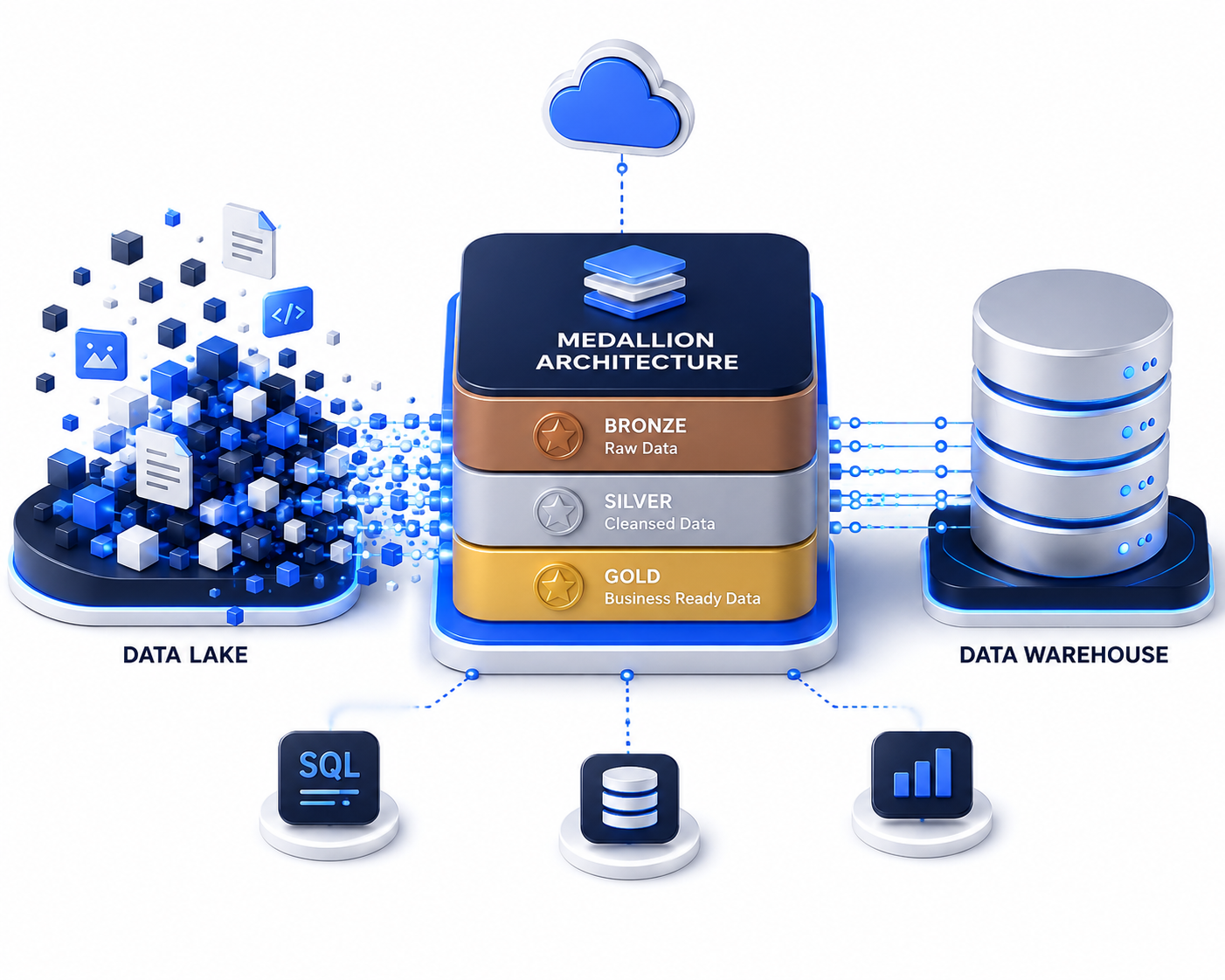
The Medallion Architecture: Organizing Data in a Lakehouse
With the technical foundation of the lakehouse in place, data engineering teams need an organizational framework for structuring their data. The medallion architecture has emerged as the de facto standard pattern for lakehouse data organization, and it maps beautifully onto the capabilities of open table formats.
The Bronze layer (also called the raw or landing layer) contains data exactly as it arrived from source systems — no transformations, no cleansing, no schema enforcement beyond the original source schema. Bronze tables are append-only; records are never modified or deleted after ingestion. This layer serves as the system of record for raw source data, enabling full historical replay and audit. In a lakehouse, bronze data is stored as Iceberg or Delta Lake tables directly on S3, with streaming ingestion from Kafka or CDC tools writing new records continuously.
The Silver layer (also called the cleansed or conformed layer) applies standardization, deduplication, null handling, and type casting to produce reliable, queryable tables that analysts and data scientists can trust. Silver tables enforce consistent schemas, resolve naming conflicts across source systems, and implement the business logic rules that define what a "valid" record looks like for each entity type. dbt is the tool of choice for building silver layer transformations, with its version-controlled SQL models, schema tests, and built-in documentation providing the governance layer that turns raw bronze data into trustworthy silver assets.
The Gold layer (also called the curated or serving layer) contains business-ready aggregations, metrics, and dimensional models optimized for specific consumption patterns — executive dashboards, operational reports, ML feature tables, and API-serving datasets. Gold tables are the most frequently queried and the most carefully governed, with strict change management processes and SLA commitments for freshness and accuracy. They represent the final, authoritative version of business metrics and should be the primary source for any business-critical reporting.
Leading Platforms Driving the Lakehouse Revolution
Databricks invented the data lakehouse concept and remains its most complete embodiment. The Databricks Lakehouse Platform unifies data engineering (Delta Live Tables for declarative pipeline development), data science (MLflow for experiment tracking, Feature Store for ML features), SQL analytics (Databricks SQL with photon query acceleration), and AI engineering (Mosaic AI for LLM fine-tuning and serving) on a single platform built on Delta Lake. For organizations that want an end-to-end platform with deep integration across all workload types, Databricks is the default choice.
Apache Iceberg has emerged as the open standard for lakehouse table formats, with support from AWS (Athena, EMR, Glue), Google (BigQuery), Snowflake, Dremio, Cloudera, and many others. Its engine-agnostic design makes it the best choice for organizations that want to avoid vendor lock-in and preserve the freedom to switch or combine query engines as their requirements evolve. The Apache Software Foundation's governance model ensures that Iceberg remains a truly open standard rather than a vendor-controlled format.
Snowflake has embraced the lakehouse paradigm through its Iceberg table support, allowing customers to store data in Iceberg format on their own S3 buckets while querying it through Snowflake's high-performance compute engine. This positions Snowflake as a compute layer that can sit on top of an open lakehouse storage layer, rather than a closed proprietary system. For existing Snowflake customers, this is the path of least resistance to adopting lakehouse capabilities without abandoning their warehouse investment.
Is the Lakehouse Right for Your Organization?
The lakehouse is not a one-size-fits-all solution, and a thoughtful evaluation of your organization's specific needs and constraints is essential before committing to a migration or greenfield build. The lakehouse delivers maximum value for organizations that have large volumes of diverse data types including both structured and unstructured data, need to support both analytical SQL workloads and machine learning training workloads on the same underlying data, are currently running separate data lake and data warehouse systems and are experiencing the governance and cost pain that comes from maintaining dual infrastructure, or are building new AI applications that require access to historical training data alongside real-time operational data.
Organizations that are primarily running simple BI workloads on structured relational data with modest scale may find that a traditional cloud data warehouse continues to meet their needs without the additional complexity of managing open table formats and multi-engine compute environments. As with all architectural decisions, the right answer depends on the specific intersection of your current pain points, your team's technical capabilities, and the data-intensive use cases on your roadmap.
The Future: Towards the Universal Data Platform
Looking ahead, the lakehouse architecture continues to evolve toward what industry analysts are calling the universal data platform — a single system that can efficiently serve every data workload: batch ETL, real-time streaming, interactive SQL analytics, machine learning training and inference, and AI application serving. The boundaries between storage, compute, and intelligence are blurring, and platforms like Databricks, Snowflake, and the emerging open-source ecosystem around Apache Iceberg are racing to close the remaining gaps.
The emergence of AI-native features built directly into lakehouse platforms is particularly significant. Vector search integrated with Iceberg tables enables semantic retrieval directly from the data lake. Real-time ML inference serving built on lakehouse infrastructure eliminates the need for a separate online feature store. Automated data quality monitoring powered by AI detects anomalies in lakehouse data without requiring manual threshold configuration. These developments suggest that the lakehouse is not just solving today's data architecture problems — it is laying the foundation for the AI-powered data infrastructure of the next decade.
Conclusion
The data lakehouse revolution is not hype. It is the architecture answer to a decade-long organizational and technical struggle with the limitations of data lakes and data warehouses used in isolation. By layering ACID transactions, rich metadata management, and multi-engine query support on top of open, low-cost cloud object storage, the lakehouse delivers what every data engineering team has always wanted: a single source of truth that is affordable at any scale, performant for every workload, and governed well enough to satisfy compliance and build organizational trust. If your organization is still maintaining separate lake and warehouse infrastructure, 2026 is the year to seriously evaluate the lakehouse path — because your competitors almost certainly already have.
Frequently Asked Questions
Q. What is a data lakehouse?
A data lakehouse is a modern data architecture that combines the low-cost, flexible storage of a data lake with the data management, ACID transactions, schema enforcement, and query performance of a data warehouse — all in a single, unified platform built on open table formats like Apache Iceberg or Delta Lake.
Q. What is the difference between a data lake, a data warehouse, and a data lakehouse?
A data lake stores raw, unstructured data cheaply but lacks query performance and governance. A data warehouse offers fast SQL queries and strong governance but is expensive and rigid. A data lakehouse merges both: it stores all data types on cheap cloud storage while supporting high-performance SQL queries, ACID transactions, and fine-grained data governance.
Q. What are the leading data lakehouse platforms in 2026?
The top platforms are Databricks (with Delta Lake), Apache Iceberg (supported by Snowflake, AWS, and Dremio), and Apache Hudi. Snowflake has also introduced Iceberg table support, effectively bringing lakehouse capabilities to its existing warehouse customers.
Q. Is the data lakehouse replacing the data warehouse?
Not replacing, but complementing and in many cases consolidating. Organizations with mature data warehouses are extending them with lakehouse capabilities rather than migrating wholesale. However, greenfield data platform projects in 2026 are predominantly choosing lakehouse architectures from the start.
Q. What open table format should I choose — Delta Lake or Apache Iceberg?
Both are excellent. Delta Lake has the strongest integration with Databricks and Spark, while Apache Iceberg has broader multi-engine support (Spark, Flink, Trino, Athena, Snowflake). If your organization is standardized on Databricks, Delta Lake is the natural choice. If you need engine-agnostic interoperability, Apache Iceberg is the better option.