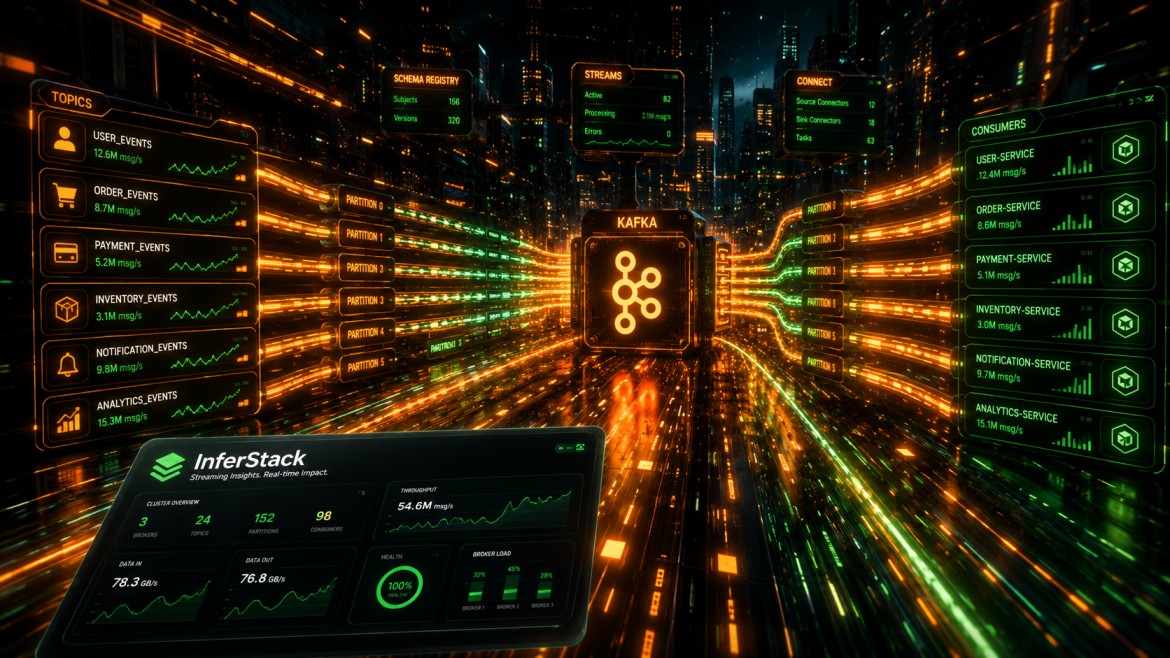
Discover everything you need to know about real-time data streaming in 2026. This ultimate guide covers Apache Kafka architecture, stream processing with Apache Flink and Spark Streaming, event-driven design patterns, and how to build low-latency data pipelines that power modern analytics and AI applications.
Introduction: The Age of Real-Time Data
We are living in the age of real-time data. From the moment a customer clicks on a product recommendation to the millisecond a financial transaction is flagged as potentially fraudulent, modern businesses are building systems that must sense, process, and respond to data streams in real time. Batch processing, where data is collected, stored, and processed in large chunks at scheduled intervals, simply cannot meet the latency and freshness requirements of today's AI-powered, hyper-personalized digital experiences.
Real-time data streaming has emerged as the foundational paradigm for the modern data stack. At the center of this revolution sits Apache Kafka — the battle-tested, horizontally scalable, fault-tolerant distributed event streaming platform that processes trillions of events per day across thousands of organizations worldwide. This guide provides a comprehensive deep dive into real-time streaming architecture, Kafka's internals, stream processing frameworks, and actionable patterns to help you build production-grade streaming systems in 2026.
What Is Real-Time Data Streaming?
Real-time data streaming refers to the continuous, unbounded flow of data records — called events — generated by applications, systems, sensors, and users, processed and acted upon as they occur rather than accumulated and batch-processed later. In a streaming system, data is treated not as a static table but as an infinite, ever-growing log of timestamped events.
The core value proposition of real-time streaming is latency reduction. Where a traditional batch pipeline might deliver analytics insights with a lag of hours or even days, a streaming pipeline delivers those same insights in seconds or milliseconds. This latency difference is the dividing line between descriptive analytics that tell you what happened yesterday and operational intelligence that enables you to act on what is happening right now.
Key applications of real-time data streaming include fraud and anomaly detection, live personalization engines, operational monitoring and alerting, real-time business dashboards, IoT data processing, event-driven microservices architectures, and continuous machine learning model inference pipelines.
Apache Kafka: Architecture and Core Concepts
Apache Kafka was originally developed at LinkedIn in 2011 to solve the challenge of managing massive volumes of activity data from hundreds of millions of users in real time. It was open-sourced and donated to the Apache Software Foundation, and has since become the de facto standard for enterprise event streaming. Understanding Kafka's architecture is essential for any data engineer working with streaming systems.
Topics and Partitions: The fundamental unit of data organization in Kafka is the topic — a named, ordered, and immutable log of events. Each topic is divided into one or more partitions, which are the unit of parallelism and scalability in Kafka. Events within a partition are strictly ordered by their offset (a monotonically increasing integer assigned to each event), but ordering is only guaranteed within a partition, not across partitions of the same topic. Partitioning allows Kafka to distribute data across multiple broker nodes, enabling horizontal scaling to handle millions of events per second.
Producers and Consumers: Producers are applications that publish events to Kafka topics. They can choose which partition to write to — either explicitly (by specifying a partition key) or via round-robin assignment. A partition key ensures that all events sharing the same key (such as a customer ID or transaction ID) are always routed to the same partition, preserving order for that entity. Consumers are applications that read events from Kafka topics. Consumers are organized into consumer groups, where each partition is consumed by exactly one consumer within a group, enabling parallel processing. Multiple consumer groups can independently consume the same topic without interfering with each other.
Brokers and Clusters: A broker is a Kafka server node responsible for storing topic partitions and serving producer and consumer requests. A Kafka cluster consists of multiple brokers working together, with data replicated across brokers for fault tolerance. Each partition has one leader broker that handles all reads and writes, and one or more follower brokers that asynchronously replicate the leader's data. If the leader fails, Kafka automatically elects a new leader from the in-sync replicas (ISR), ensuring zero data loss and continuous availability.
Retention and Log Compaction: Unlike traditional message queues that delete messages after consumption, Kafka retains events for a configurable retention period (or indefinitely). This means consumers can replay historical events, recover from failures by rewinding their offset, and new consumers can bootstrap from the beginning of a topic. Log compaction is an alternative retention policy where Kafka keeps only the latest event for each unique key, making it ideal for use cases like maintaining a changelog of the latest state of each entity.
Kafka Connect and Schema Registry: Kafka Connect is a framework for building and running source connectors (that pull data from external systems like databases, APIs, and S3 into Kafka) and sink connectors (that push data from Kafka into destinations like data warehouses, Elasticsearch, or other databases) without writing custom code. The Schema Registry provides a centralized repository for managing Avro, Protobuf, or JSON Schema definitions for Kafka topics, ensuring that producers and consumers agree on the schema of events and enabling safe schema evolution with backward and forward compatibility guarantees.
Stream Processing: From Raw Events to Business Intelligence
Ingesting events into Kafka is only the first step. The real value comes from processing those event streams to compute real-time metrics, detect patterns, enrich events with reference data, and trigger downstream actions. Two frameworks dominate the stream processing landscape in 2026: Apache Flink and Apache Spark Structured Streaming.
Apache Flink is the gold standard for stateful, low-latency stream processing. Flink processes events one at a time as they arrive (true streaming), maintains complex state across millions of concurrent event windows, and provides exactly-once processing semantics through its sophisticated checkpointing mechanism. Flink excels at use cases requiring precise event-time processing, complex event pattern detection (using Flink's CEP library), and sub-second latency at scale. Its native Kafka integration and rich SQL and DataStream API make it accessible to both data engineers and data analysts.
Apache Spark Structured Streaming treats a real-time stream as an unbounded DataFrame and applies the same familiar Spark DataFrame API to both batch and streaming workloads. Spark processes data in micro-batches (configurable trigger intervals from seconds to minutes), which introduces slightly higher latency than true streaming but simplifies state management and enables tight integration with Spark's machine learning (MLlib) and SQL (Spark SQL) ecosystems. Structured Streaming is an excellent choice for teams already invested in the Spark ecosystem who need streaming capabilities with lower operational complexity.
Kafka Streams is a lightweight Java library for stream processing that runs directly inside your application process — no separate cluster required. For simpler streaming use cases like event enrichment, aggregations, and filtering, Kafka Streams offers a low-overhead option that is easy to deploy and operate. It is particularly well-suited for microservices architectures where each service needs to consume and produce Kafka events with local state.
Key Stream Processing Patterns Every Data Engineer Should Know
Streaming systems surface a set of recurring design patterns that every data engineer working with real-time data needs to master:
Windowing: Since event streams are unbounded, aggregations must be computed over finite windows of time. Kafka and Flink support tumbling windows (fixed-size, non-overlapping time intervals), sliding windows (overlapping windows that slide forward at a regular step), session windows (variable-length windows defined by periods of user inactivity), and global windows. Choosing the right window type depends on your analytical use case and latency requirements.
Event-Time vs. Processing-Time: Events in a stream have two timestamps: the time they were generated (event time) and the time they arrived at the processing engine (processing time). Network delays, mobile devices going offline, and slow upstream systems mean events frequently arrive out of order. Processing based on event time requires watermarks — a mechanism that tracks the progress of event time and defines how long the system waits for late-arriving events before finalizing window results. Apache Flink has the most sophisticated event-time and watermark handling of any stream processing framework.
Stateful Processing and State Backends: Many streaming applications need to maintain state between events — for example, tracking a running count of events per user, maintaining a rolling average, or detecting that a sequence of events matches a specific pattern. Flink stores this state in a pluggable state backend (in-memory RocksDB, or remote state stores) and periodically checkpoints the state to durable storage like S3 or HDFS, enabling recovery to a consistent state after failures with exactly-once guarantees.
Stream-Table Joins (Enrichment): Real-time events often need to be enriched with reference data — for example, joining a clickstream event with user profile data or product catalog information. This can be done by joining a Kafka stream with a compacted Kafka topic (which maintains the latest state of each entity), effectively implementing a real-time lookup table that is always up to date as the underlying data changes.
Change Data Capture (CDC): Change Data Capture is a technique for capturing every INSERT, UPDATE, and DELETE operation in a relational database as a Kafka event stream, using database replication logs. Tools like Debezium (open-source) and AWS DMS enable CDC from PostgreSQL, MySQL, MongoDB, and other databases into Kafka with sub-second latency. CDC is the cornerstone of event-driven microservices architectures and real-time data synchronization between operational databases and analytical systems.
Building a Production Real-Time Streaming Architecture
A production-grade streaming architecture for a modern data-driven organization typically consists of the following layers working in concert:
The ingestion layer uses Debezium CDC connectors to stream database changes into Kafka, custom producer SDKs to emit application events from microservices, IoT gateway connectors for device telemetry, and Kafka Connect source connectors for SaaS APIs. All events are serialized using Avro or Protobuf schemas registered in the Schema Registry.
The stream processing layer runs Apache Flink jobs deployed on Kubernetes that consume events from Kafka, perform enrichment joins, compute real-time metrics in tumbling and sliding windows, detect anomaly patterns using CEP, and produce processed results back to Kafka output topics or directly to downstream sinks.
The serving layer consists of multiple materialized destinations: a real-time OLAP database like Apache Druid or ClickHouse for low-latency analytical queries on streaming data, Elasticsearch for full-text search and operational dashboards, a cloud data warehouse for long-term historical analysis, and a real-time feature store for online machine learning inference.
The observability layer monitors Kafka consumer group lag (the primary indicator of pipeline health and throughput bottlenecks), end-to-end event latency from source to destination, Flink job checkpoint success rates and durations, and data quality metrics emitted from validation steps in the processing pipeline.
Best Practices for Real-Time Streaming at Scale
Operating streaming systems reliably at scale requires adherence to battle-tested best practices. Always design your Kafka topics with partition counts that match your target parallelism — under-partitioning creates processing bottlenecks while over-partitioning increases cluster overhead. Use a replication factor of at least 3 for production topics and set minimum in-sync replicas to 2 to prevent data loss during broker failures.
Implement dead-letter queues (DLQ topics) for events that fail processing due to schema violations, unexpected data types, or application errors. Without a DLQ, a single malformed event can stall your entire consumer group. Monitor consumer group lag continuously and set up automated alerts when lag exceeds defined thresholds — unbounded lag growth is the earliest warning sign of a processing bottleneck.
For Flink jobs, enable incremental checkpointing with RocksDB state backend to minimize checkpoint overhead for jobs with large state. Set appropriate restart strategies and configure the maximum number of concurrent checkpoints to balance recovery speed with processing throughput. Always test failure scenarios — kill random task managers during load tests to verify that your job recovers correctly and that exactly-once semantics hold.
The Future of Streaming: Unified Batch and Stream Processing
The boundary between batch and stream processing continues to dissolve in 2026. The lakehouse architecture pioneered by Apache Iceberg and Delta Lake enables data lakes to support both streaming ingest (millisecond-latency inserts) and high-performance batch reads, eliminating the traditional "lambda architecture" that required maintaining separate batch and streaming code paths. Platforms like Apache Paimon and Hudi are pushing this further by supporting incremental processing directly on the lakehouse storage layer.
Artificial intelligence is also transforming stream processing. ML-powered anomaly detection models run directly in Flink pipelines for real-time fraud detection. Generative AI is being applied to generate streaming pipeline code from natural language descriptions. And AI-driven stream processing platforms like InferStack are emerging that automatically tune Kafka partition strategies, Flink parallelism settings, and checkpoint intervals based on observed workload patterns — dramatically reducing the operational burden on data engineering teams.
Conclusion
Real-time data streaming has evolved from a niche capability to a core competency for any organization that wants to compete in the data-driven economy of 2026. Apache Kafka provides the rock-solid foundation for ingesting and distributing event streams at any scale, while Apache Flink and Spark Structured Streaming give data engineers the tools to transform those streams into actionable intelligence with sub-second latency. By mastering the concepts, patterns, and best practices outlined in this guide, you will be equipped to design, build, and operate streaming systems that unlock the true real-time potential of your organization's data. The future belongs to organizations that can not only store and analyze their data but react to it at the speed of business.
Frequently Asked Questions
Q. What is real-time data streaming?
Real-time data streaming is the continuous processing of data as it is generated, enabling organizations to react to events within milliseconds rather than waiting for batch processing cycles that run hourly or daily.
Q. What is Apache Kafka used for?
Apache Kafka is a distributed event streaming platform used for building high-throughput, fault-tolerant, real-time data pipelines, event-driven architectures, and streaming analytics applications across industries.
Q. What is the difference between Apache Kafka and Apache Flink?
Apache Kafka is a distributed message broker and event streaming platform designed to ingest and store high-volume event streams, while Apache Flink is a stateful stream processing engine that reads from Kafka and performs real-time computations, aggregations, and transformations on those streams.
Q. How does Apache Kafka achieve fault tolerance?
Kafka achieves fault tolerance through data replication across multiple broker nodes. Each partition of a Kafka topic is replicated to a configurable number of brokers, ensuring that if one broker fails, another replica can immediately take over without data loss.
Q. What are common use cases for real-time data streaming?
Common use cases include real-time fraud detection in financial transactions, live recommendation engines in e-commerce, IoT sensor data processing, real-time operational monitoring and alerting, clickstream analytics, and feeding machine learning models with fresh training data.