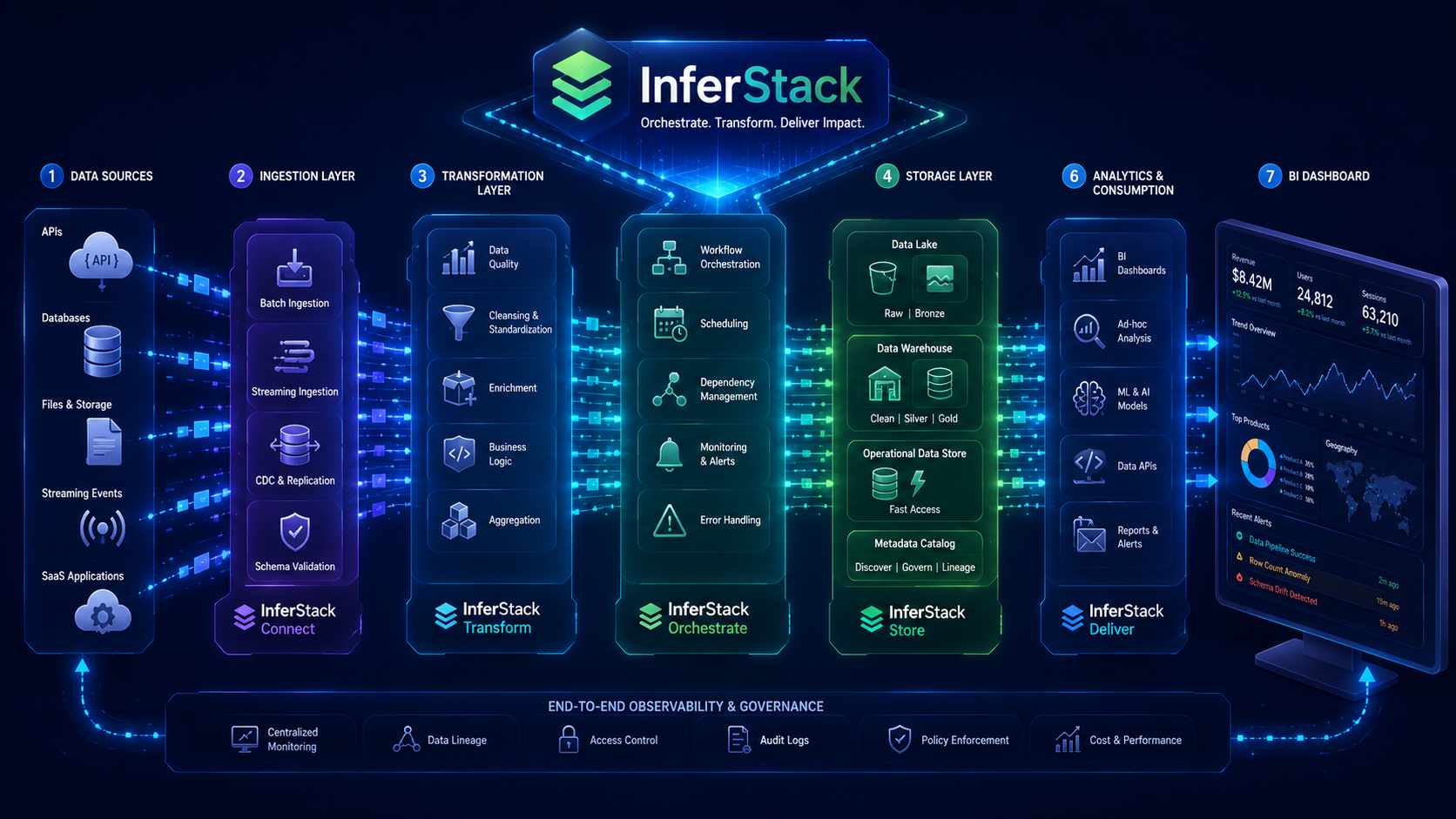
Learn how to build a modern data pipeline from scratch in 2026. This complete guide covers ETL vs ELT, pipeline architecture, best tools like Apache Kafka, Apache Spark, dbt, and Airflow — with real-world examples to help data engineers at every level.
Introduction: Why Data Pipelines Are the Backbone of Modern Businesses
In 2026, data is no longer just an asset — it is the competitive engine that drives intelligent decision-making, powers AI models, and fuels real-time analytics. At the heart of every data-driven organization lies a modern data pipeline: a robust, automated system that seamlessly collects, processes, and delivers data from diverse sources to destinations where it can be analyzed and acted upon.
Whether you are a startup building your first analytics stack or an enterprise scaling to petabytes of daily data, understanding how to design and implement a modern data pipeline is one of the most critical skills in data engineering today. This comprehensive guide walks you through everything you need to know — from fundamental concepts and architecture patterns to the best open-source and cloud-native tools available in 2026.
What Is a Data Pipeline?
A data pipeline is a set of automated processes that extract data from one or more sources, apply transformations or business logic, and load it into a target system such as a data warehouse, data lake, or operational database. Think of it as a digital assembly line where raw, unstructured data enters at one end and clean, structured, analytics-ready data exits at the other.
Modern data pipelines go far beyond simple data movement. They handle schema evolution, enforce data quality rules, support real-time streaming, provide observability and alerting, and scale elastically with the volume of incoming data. In short, they are the plumbing infrastructure that makes the modern data stack possible.
ETL vs ELT: Choosing the Right Architecture
One of the first architectural decisions you will face when building a data pipeline is whether to follow the ETL (Extract, Transform, Load) or ELT (Extract, Load, Transform) pattern.
ETL is the traditional approach where data is extracted from source systems, transformed in a staging layer or on a dedicated processing engine, and then loaded into the destination in a clean, processed state. This works well for legacy on-premises data warehouses with limited compute capacity. However, ETL pipelines can become bottlenecks as data volumes grow because all transformation logic must be completed before data reaches the warehouse.
ELT, on the other hand, loads raw data directly into a cloud data warehouse first, leveraging the warehouse's own massive parallel processing power to perform transformations at query time or through scheduled SQL transformations. Platforms like Snowflake, Google BigQuery, and Amazon Redshift are designed precisely for this pattern, making ELT the preferred approach for most modern cloud-native architectures. Tools like dbt (data build tool) have made ELT even more accessible by enabling software engineering best practices — version control, testing, and documentation — for SQL-based transformations.
The right choice depends on your use case, but in 2026, ELT is generally recommended for analytics workloads due to its scalability, simplicity, and lower operational overhead.
Key Components of a Modern Data Pipeline
A well-designed modern data pipeline consists of several interconnected components, each serving a specific purpose in the data flow:
1. Data Ingestion Layer: This is where data enters the pipeline from source systems such as databases, APIs, event streams, SaaS applications, IoT sensors, and log files. Tools like Apache Kafka, AWS Kinesis, Fivetran, and Airbyte are commonly used for ingestion. Kafka, in particular, is the industry standard for high-throughput, fault-tolerant event streaming, capable of processing millions of events per second with sub-millisecond latency.
2. Data Processing and Transformation Layer: Once ingested, raw data must be cleaned, enriched, and transformed into useful formats. Apache Spark is the gold standard for large-scale distributed batch processing, while Apache Flink leads in stateful stream processing for real-time use cases. For SQL-based transformations on top of a cloud data warehouse, dbt has become the tool of choice for thousands of data teams worldwide.
3. Data Storage Layer: Processed data lands in storage systems optimized for different access patterns. Cloud data warehouses like Snowflake, BigQuery, and Redshift are ideal for structured analytical queries. Data lakes built on Amazon S3, Azure Data Lake, or Google Cloud Storage store raw and semi-structured data at low cost. The emerging data lakehouse architecture, championed by platforms like Databricks Delta Lake and Apache Iceberg, combines the best of both worlds — the flexibility of a data lake with the performance and governance of a data warehouse.
4. Orchestration Layer: Data pipelines need a conductor to schedule, monitor, and manage complex task dependencies. Apache Airflow remains the most widely adopted workflow orchestration tool, with its Python-based DAG (Directed Acyclic Graph) model providing enormous flexibility. Newer alternatives like Prefect, Dagster, and Mage offer improved developer experience, better observability, and cloud-native deployment options.
5. Data Quality and Observability Layer: No modern data pipeline is complete without robust data quality checks and monitoring. Tools like Great Expectations, Monte Carlo, and dbt tests help enforce schema contracts, detect anomalies, and alert teams to data incidents before they impact downstream consumers. Data observability — understanding the health, freshness, and lineage of your data — has become a top priority for mature data engineering teams.
Step-by-Step: Building Your First Modern Data Pipeline
Here is a practical walkthrough for building a production-ready data pipeline in 2026:
Step 1 — Define Your Data Sources and Requirements: Start by cataloging all data sources you need to ingest — operational databases (PostgreSQL, MySQL), SaaS tools (Salesforce, Stripe), event streams, or flat files. Understand the ingestion frequency (real-time vs. batch), data volumes, and the downstream analytical use cases. This requirements gathering phase prevents costly architectural rework later.
Step 2 — Choose Your Ingestion Method: For batch ingestion of structured data from databases, use a managed connector tool like Airbyte or Fivetran for rapid setup with minimal code. For event-driven or streaming data, deploy Apache Kafka with appropriate source connectors using Kafka Connect. Define your topic schemas using Avro or Protobuf with a Schema Registry to enforce contracts between producers and consumers.
Step 3 — Select Your Processing and Storage Stack: For most data teams in 2026, the recommended stack is: Airbyte or Fivetran for ingestion, a cloud data warehouse (Snowflake or BigQuery) as the central storage layer, and dbt for transformations. If you have real-time processing requirements, add Apache Flink or Spark Structured Streaming to your stack for stream processing before data lands in the warehouse.
Step 4 — Model Your Data with dbt: Use dbt to create a layered data model following the medallion architecture — raw/bronze layer (unmodified source data), silver layer (cleaned and conformed data), and gold layer (business-ready aggregations and metrics). Write dbt models as SELECT SQL statements, add schema tests for not-null and uniqueness constraints, and document every model using dbt's built-in documentation features.
Step 5 — Orchestrate with Airflow: Define Apache Airflow DAGs that schedule your ingestion jobs, trigger dbt runs after ingestion completes, run data quality tests post-transformation, and send alerts to Slack or PagerDuty on failures. Use Airflow's task dependencies to create a clear execution graph that makes the pipeline logic explicit and debuggable.
Step 6 — Implement Monitoring and Alerting: Set up data freshness checks to detect stale data, row count anomaly detection to catch unexpected drops or spikes, schema drift alerts for unexpected upstream changes, and end-to-end pipeline latency tracking. Tools like Monte Carlo, Bigeye, or open-source options like Elementary (built on dbt) provide these capabilities out of the box.
Best Practices for Production Data Pipelines
Building a data pipeline that works in development is very different from running one reliably in production at scale. Here are the most important best practices to follow:
Design for idempotency: Every pipeline step should produce the same result when run multiple times with the same input. This makes reruns safe after failures and eliminates data duplication issues. Use incremental load patterns with watermarks or change data capture (CDC) rather than full refreshes wherever possible.
Version control everything: Store all pipeline code — Airflow DAGs, dbt models, Spark jobs, Kafka configurations — in Git. Use feature branches, pull request reviews, and CI/CD pipelines to test changes before deploying to production. This brings software engineering discipline to data infrastructure and dramatically reduces incidents caused by unreviewed changes.
Partition your data strategically: Partition large datasets by date, region, or another high-cardinality dimension that matches your most common query patterns. In Spark and data lake environments, proper partitioning can reduce query times from minutes to seconds by enabling partition pruning.
Handle schema evolution gracefully: Upstream data sources change over time — columns get added, renamed, or removed. Use schema registries, contract testing, and tools like dbt source freshness checks to detect and handle schema changes before they break downstream consumers.
Build with observability from day one: Do not treat monitoring as an afterthought. Instrument your pipelines with logging, metrics, and traces from the start. Define SLAs for data freshness and alerting thresholds for anomaly detection before going to production.
The Future of Data Pipelines: AI-Augmented Engineering
Looking ahead, the data pipeline landscape is being shaped by the convergence of data engineering and artificial intelligence. AI-augmented data engineering tools are emerging that can automatically generate pipeline code from natural language descriptions, detect and fix data quality issues autonomously, optimize query execution plans, and predict pipeline failures before they occur.
Platforms like InferStack are at the forefront of this evolution, combining cloud-native data engineering expertise with AI-powered automation to help businesses build intelligent, self-healing data infrastructure that scales effortlessly. As the volume and velocity of data continue to grow exponentially, the organizations that invest in modern, well-architected data pipelines today will have an insurmountable advantage in the AI-driven economy of tomorrow.
Conclusion
Building a modern data pipeline in 2026 is both an art and a science. It requires a clear understanding of your data sources and downstream requirements, thoughtful architectural decisions around ETL vs ELT, careful selection of best-in-class tools across ingestion, processing, storage, and orchestration, and a strong operational discipline around testing, monitoring, and version control. By following the principles and practices outlined in this guide, you will be well-equipped to design and implement a data pipeline that is reliable, scalable, and ready for the demands of a data-first world.
Frequently Asked Questions
Q. What is a modern data pipeline?
A modern data pipeline is an automated system that moves, transforms, and loads data from multiple sources into a centralized destination like a data warehouse or data lake, enabling real-time or batch analytics at scale.
Q. What are the best tools for building a data pipeline in 2026?
The top tools include Apache Kafka for streaming ingestion, Apache Spark for large-scale processing, dbt for data transformation, Apache Airflow for orchestration, and Snowflake or BigQuery as cloud data warehouses.
Q. What is the difference between ETL and ELT?
ETL (Extract, Transform, Load) transforms data before loading it into the destination, while ELT (Extract, Load, Transform) loads raw data first and transforms it inside the warehouse. ELT is preferred in modern cloud-native architectures.
Q. How long does it take to build a data pipeline?
Depending on complexity, a basic data pipeline can be built in a few days, while enterprise-grade pipelines with multiple data sources, transformations, and monitoring can take weeks to months.
Q. Why is data pipeline monitoring important?
Monitoring ensures data freshness, catches failures early, maintains data quality, and prevents costly downstream errors in analytics dashboards and machine learning models.