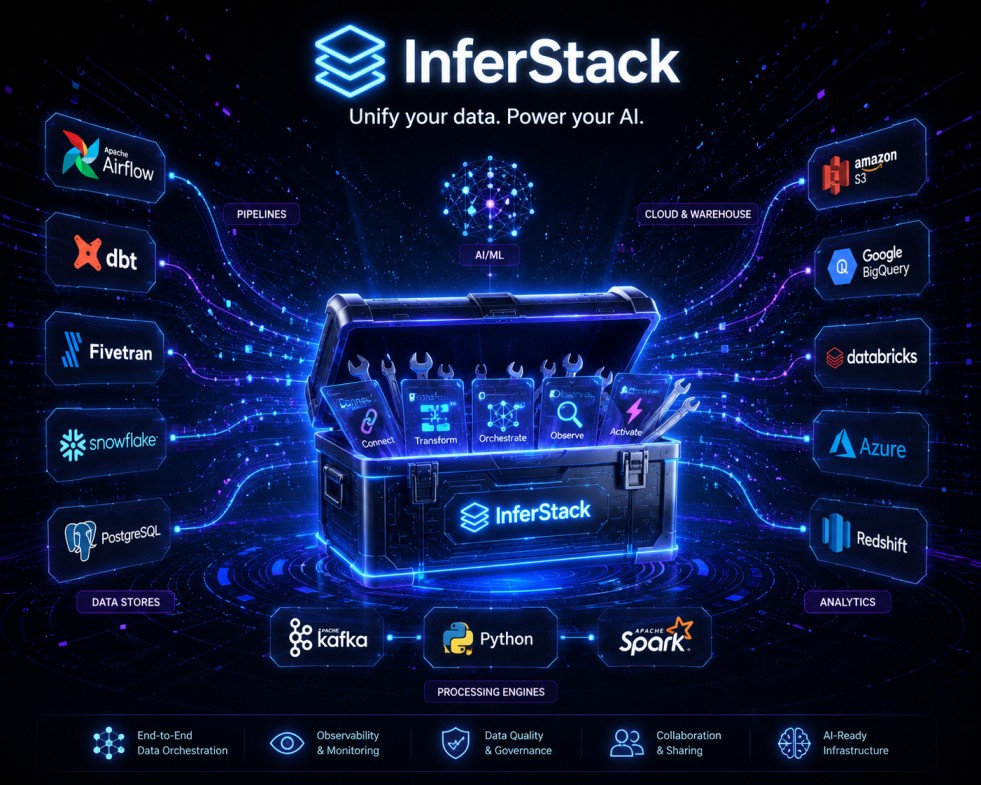
Discover the top 10 data engineering tools every web developer should master in 2026. From Apache Kafka to dbt and Snowflake, learn which tools power scalable, data-driven web applications.
Web development is no longer just about clean UIs and fast APIs. Modern web applications run on data — user events, analytics, recommendations, personalization, AI features, and real-time dashboards. If you are building anything beyond a static site in 2026, understanding data engineering tools is no longer optional.
At InferStack, we work at the intersection of data engineering and web development, and we have seen one pattern repeat: the teams that ship faster, scale cheaper, and break less are the ones who pick the right data stack early.
In this guide, we break down the top 10 data engineering tools every web developer should know in 2026, what each one solves, and when to reach for it.
Why Web Developers Should Care About Data Engineering Tools
Modern web apps generate and consume massive volumes of data. Whether you are building a SaaS dashboard, an e-commerce platform, or an AI-powered product, you will eventually need to:
- Move data between databases, APIs, and warehouses
- Transform raw events into clean, query-ready tables
- Orchestrate workflows that run on schedule or in real time
- Power analytics, search, and AI features without slowing down your app
The right modern data stack lets you do all of this without reinventing the wheel. Let's get into the tools.
1. Apache Kafka — Real-Time Data Streaming
Best for: real-time data pipelines, event-driven architectures, microservices communication.
Apache Kafka is the industry standard for real-time data streaming. Used by over 40,000 companies globally, Kafka handles low-latency, high-throughput event streams between services — think chat apps, live notifications, fraud detection, and live dashboards.
For web developers, Kafka shines when your app needs to process user events as they happen instead of in nightly batches. If you have ever wanted "live" anything in your product, Kafka is the backbone.
Key features: fault-tolerant distributed architecture, horizontal scalability, low-latency message delivery, rich connector ecosystem.
2. Apache Spark — Large-Scale Data Processing
Best for: big data transformation, batch ETL, machine learning workloads.
Apache Spark is a distributed data processing engine built for speed. Using in-memory computation across clusters, Spark processes terabytes of data faster than traditional batch frameworks. It supports SQL, Python (PySpark), Scala, and Java — so your team can use whatever fits.
Web developers working with analytics-heavy applications, recommendation engines, or AI pipelines will run into Spark sooner or later. It is the workhorse of modern data engineering.
Key features: in-memory processing, multi-language APIs, unified batch and streaming, native ML library (MLlib).
3. Snowflake — Cloud Data Warehouse
Best for: scalable cloud data warehousing, analytics, data sharing.
Snowflake is one of the most popular cloud data warehouses in 2026. Its separation of compute and storage means you pay only for what you use, and it scales instantly with demand. For web teams, Snowflake is often the central source of truth where product data, marketing data, and user analytics all converge.
If your web app needs to power BI dashboards, customer-facing analytics, or AI features, Snowflake is a top contender alongside BigQuery and Databricks.
Key features: auto-scaling compute, zero-copy data sharing, multi-cloud support, built-in AI features via Snowflake Cortex.
4. dbt (data build tool) — SQL-Based Data Transformation
Best for: transforming data inside your warehouse using SQL, version-controlled analytics.
dbt has become the default transformation layer in the modern data stack. It lets data engineers and analysts model data using simple SQL, with version control, testing, and documentation built in. dbt Core is open source, and dbt Cloud offers a managed experience.
For web developers, dbt bridges the gap between raw application data and the clean, modeled tables your frontend dashboards or APIs consume.
Key features: SQL-first transformations, Git-based workflows, automated testing, lineage and documentation.
5. Apache Airflow — Workflow Orchestration
Best for: scheduling and orchestrating complex data pipelines.
Apache Airflow is the most widely adopted workflow orchestration tool in data engineering. Pipelines are defined as Python code (DAGs), making them easy to version, test, and debug. Airflow handles scheduling, retries, dependencies, and monitoring.
If your web application runs nightly reports, batch jobs, ML training, or any multi-step data workflow, Airflow keeps it reliable and observable.
Key features: Python-based DAGs, rich scheduling, extensible operators, active open-source community.
6. Airbyte — Open-Source Data Ingestion
Best for: moving data from SaaS apps, databases, and APIs into your warehouse.
Airbyte is leading the open-source ELT revolution. With 400+ pre-built connectors, it lets you replicate data from sources like Postgres, Stripe, HubSpot, and Salesforce into Snowflake, BigQuery, or Redshift — without writing custom ETL code.
For web developers, Airbyte eliminates one of the most painful parts of building data-driven apps: integrating third-party data sources.
Key features: open-source and cloud options, 400+ connectors, schema change detection, custom connector SDK.
7. Databricks — Unified Data + AI Platform
Best for: lakehouse architecture, machine learning, large-scale analytics.
Databricks pioneered the lakehouse architecture, combining the flexibility of data lakes with the performance of data warehouses. Built on Apache Spark, it unifies data engineering, analytics, and ML on a single platform.
If your web product has AI features — recommendations, search ranking, LLM-powered tools — Databricks is one of the strongest platforms in 2026 for building the data + ML foundation behind them.
Key features: lakehouse architecture, MLflow integration, Delta Lake, collaborative notebooks, Mosaic AI.
8. Google BigQuery — Serverless Data Warehouse
Best for: serverless analytics, fast SQL queries on massive datasets.
BigQuery is Google Cloud's fully managed, serverless data warehouse. It scales automatically, charges per query, and handles petabyte-scale analytics with minimal setup. For teams already on Google Cloud or Firebase, BigQuery is often the path of least resistance.
Web developers love BigQuery for its zero infrastructure overhead — no clusters to manage, no servers to size.
Key features: serverless architecture, standard SQL, built-in ML (BigQuery ML), real-time analytics, generous free tier.
9. Apache Iceberg — Open Table Format
Best for: modern lakehouse architectures, multi-engine analytics, vendor-neutral storage.
Apache Iceberg has emerged as the default open table format for new lakehouse deployments in 2026. It lets multiple engines (Spark, Trino, Snowflake, BigQuery) read and write the same data without lock-in, making it the cornerstone of cloud-portable data architectures.
For web teams worried about long-term vendor lock-in, Iceberg gives you flexibility to swap engines without rewriting your data layer.
Key features: ACID transactions, schema evolution, time travel, engine-agnostic, multi-cloud support.
10. Docker and Kubernetes — Infrastructure for Data Pipelines
Best for: containerizing and deploying data engineering workloads.
Docker and Kubernetes are not data tools per se, but they are the infrastructure backbone of nearly every modern data platform. From running Airflow to deploying ML models behind your web app's APIs, containerization ensures consistency between development, staging, and production.
Web developers already familiar with Docker have a head start in data engineering — the same skills carry over directly.
Key features: environment consistency, horizontal scaling, declarative deployments, ecosystem of operators for data tools.
How to Choose the Right Data Engineering Stack in 2026
You do not need all 10 tools. The right stack depends on your scale, team size, and use case. Here is a quick recommendation:
For early-stage startups: Airbyte + BigQuery + dbt + Airflow. Lightweight, cost-effective, and easy to scale.
For mid-size SaaS products: Snowflake or Databricks + dbt + Airflow + Kafka for real-time features.
For enterprise: Databricks or Snowflake + dbt Cloud + Airflow + Iceberg + Kafka + Kubernetes.
The principle that has held up consistently in 2026: add tools only when your team is actively losing on the problem they solve. Premature complexity is the silent killer of data projects.
Bringing Data Engineering and Web Development Together
At InferStack, we believe the boundary between data engineering and web development is dissolving. The next generation of web applications — AI-powered, real-time, deeply personalized — runs on solid data infrastructure underneath.
Whether you are building a SaaS platform, an analytics product, or an AI-first web app, mastering these data engineering tools will give you a massive edge in 2026 and beyond.
Need help designing your data stack or integrating data engineering into your web product?
We help startups and growing companies build scalable, production-grade data pipelines and modern web applications. Get in touch with InferStack → Muhammad Uzair
Frequently Asked Questions
Q. What is the difference between ETL and ELT?
ETL (Extract, Transform, Load) transforms data before loading it into a destination. ELT (Extract, Load, Transform) loads raw data first and transforms it inside the warehouse. ELT is the modern, cloud-friendly approach and is what most 2026 stacks use.
Q. Which is the best data engineering tool for beginners?
For beginners, start with BigQuery + Airbyte + dbt Core. These tools have gentle learning curves, generous free tiers, and excellent documentation.
Q. Do web developers really need to learn data engineering?
You do not need to become a full data engineer, but understanding the modern data stack will make you significantly more valuable. Most production web apps in 2026 require some form of data pipeline, analytics, or AI integration.
Q. Is Snowflake better than BigQuery?
Both are excellent. Snowflake offers more flexibility across clouds and better data sharing features. BigQuery has tighter Google Cloud integration and a simpler serverless model. Choose based on your cloud provider and team familiarity.